For Your Legal Knowledge: What Is the Crime of Torture?
Article 5 of the “Universal Declaration of Human Rights” adopted by the United Nations on December 10, 1948, states: “No one shall be subjected to torture or to cruel, inhuman or degrading treatment or punishment.” This marked the beginning of the concept of opposing torture.
Likewise, Article 7 of the “International Covenant on Civil and Political Rights,” adopted on December 16, 1966, states:
“No one shall be subjected to torture or to cruel, inhuman or degrading treatment or punishment.”
With the aim of completely eliminating, prohibiting and preventing torture throughout the world, the “Convention against Torture and Other Cruel, Inhuman or Degrading Treatment or Punishment” was adopted on December 10, 1984.
Article 1, Paragraph 1 of the Convention provides:
“Torture means any intentional act by which severe pain or suffering, whether physical or mental, is inflicted on a person or a third person for such purposes as obtaining from him or a third person information or a confession, punishing him for an act he or a third person has committed or is suspected of having committed, intimidating or coercing him, or for any reason based on discrimination of any kind, when such pain or suffering is inflicted at the instigation of or with the explicit or implicit consent of a public official or other person acting in an official capacity.”
Mongolia officially acceded to the Convention on January 24, 2002.
The Convention against Torture distinguishes between two forms: “mental torture” and “physical torture.”
Mental torture is internationally defined and understood to include solitary confinement, intimidation, humiliation and insult, mockery and ridicule, defamation, spreading false information, showing images of others being tortured, spreading distressing information about family members and loved ones, and depriving a person of food and drink, while physical torture includes acts such as beating, tight handcuffing, electric shocks, submerging the head in water, suffocation, burning and cutting.
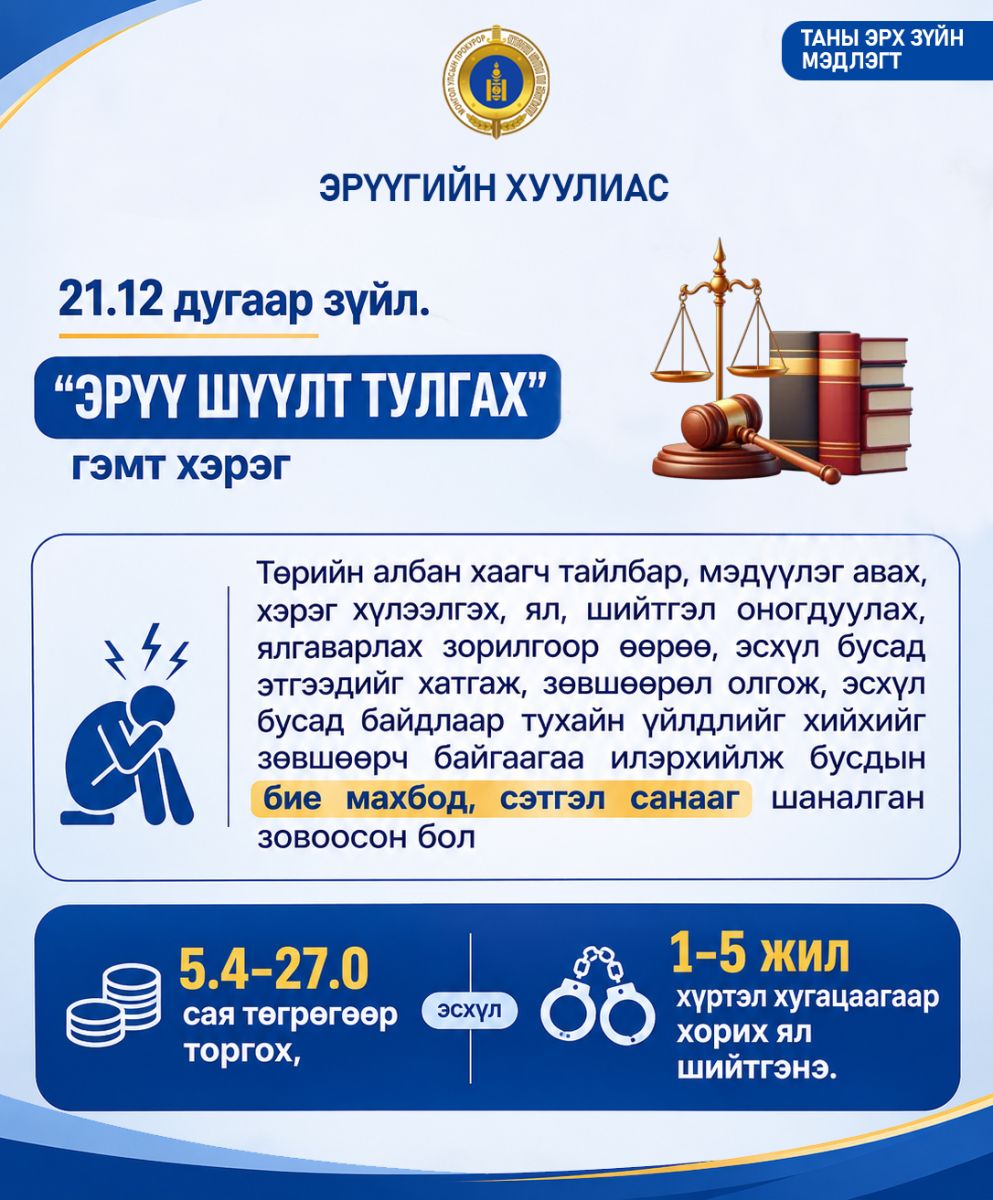
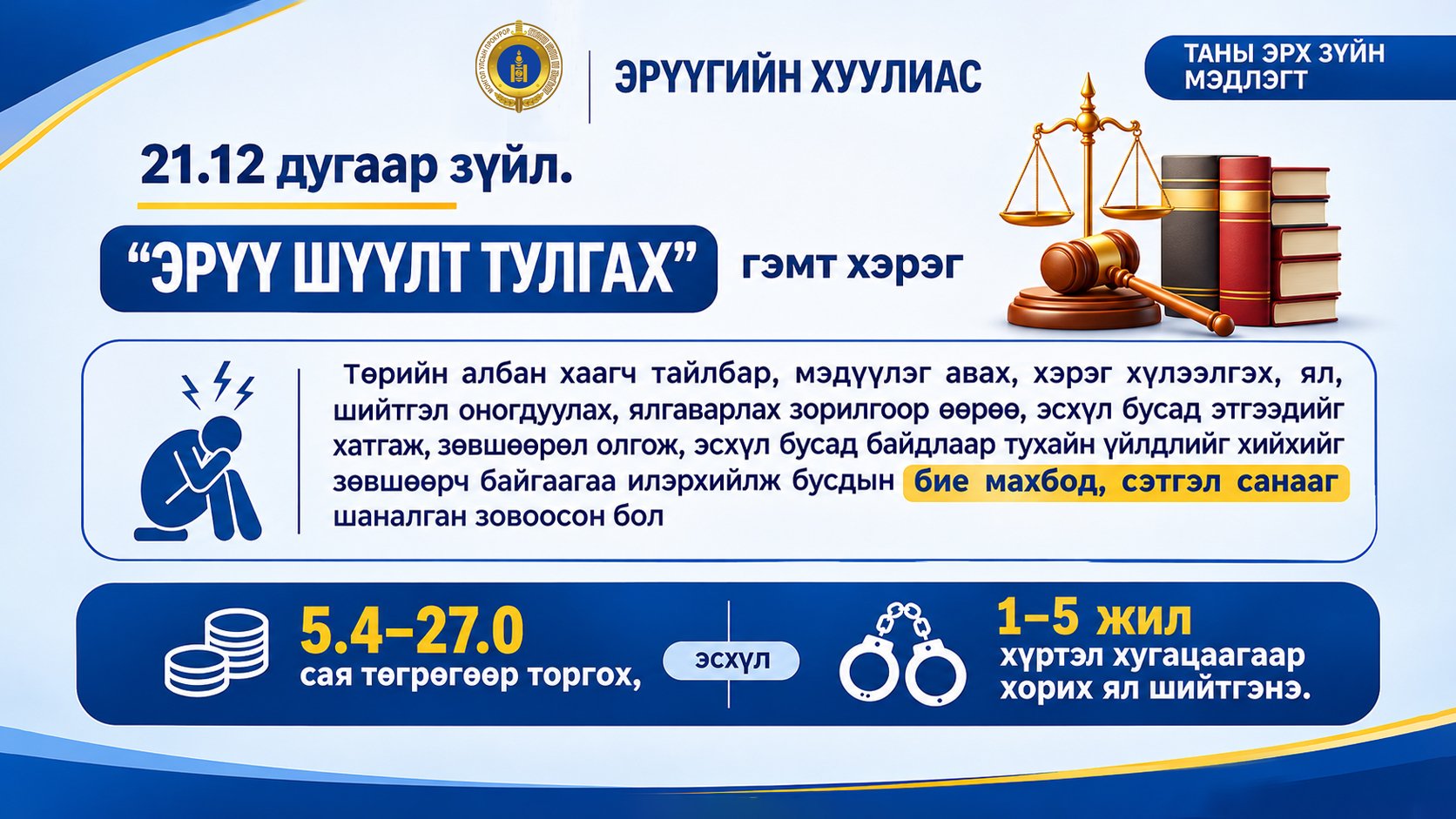
Article 21.12 of the Criminal Code of Mongolia criminalizes the act of “Torture.” Specifically:
“If a public servant, for the purpose of obtaining an explanation or testimony, extracting a confession, imposing a punishment or penalty, or discrimination, causes physical or mental suffering to another person, either personally or by inciting or authorizing others, or by otherwise expressing consent to such an act, he or she shall be punished by a fine of 5.4 million MNT to 27 million MNT, or imprisonment for a period of 1 to 5 years.”
Of note, an article on the study “Reported Methods, Distributions, and Frequencies of Torture Globally,” published in the journal “JAMA Network Open” in 2023, states that although 173 countries have acceded to the UN Convention against Torture, torture has been recorded in 141 countries.