
The Role of the Prosecutor in Recovering Proceeds of Crime: The Experience of Mongolia
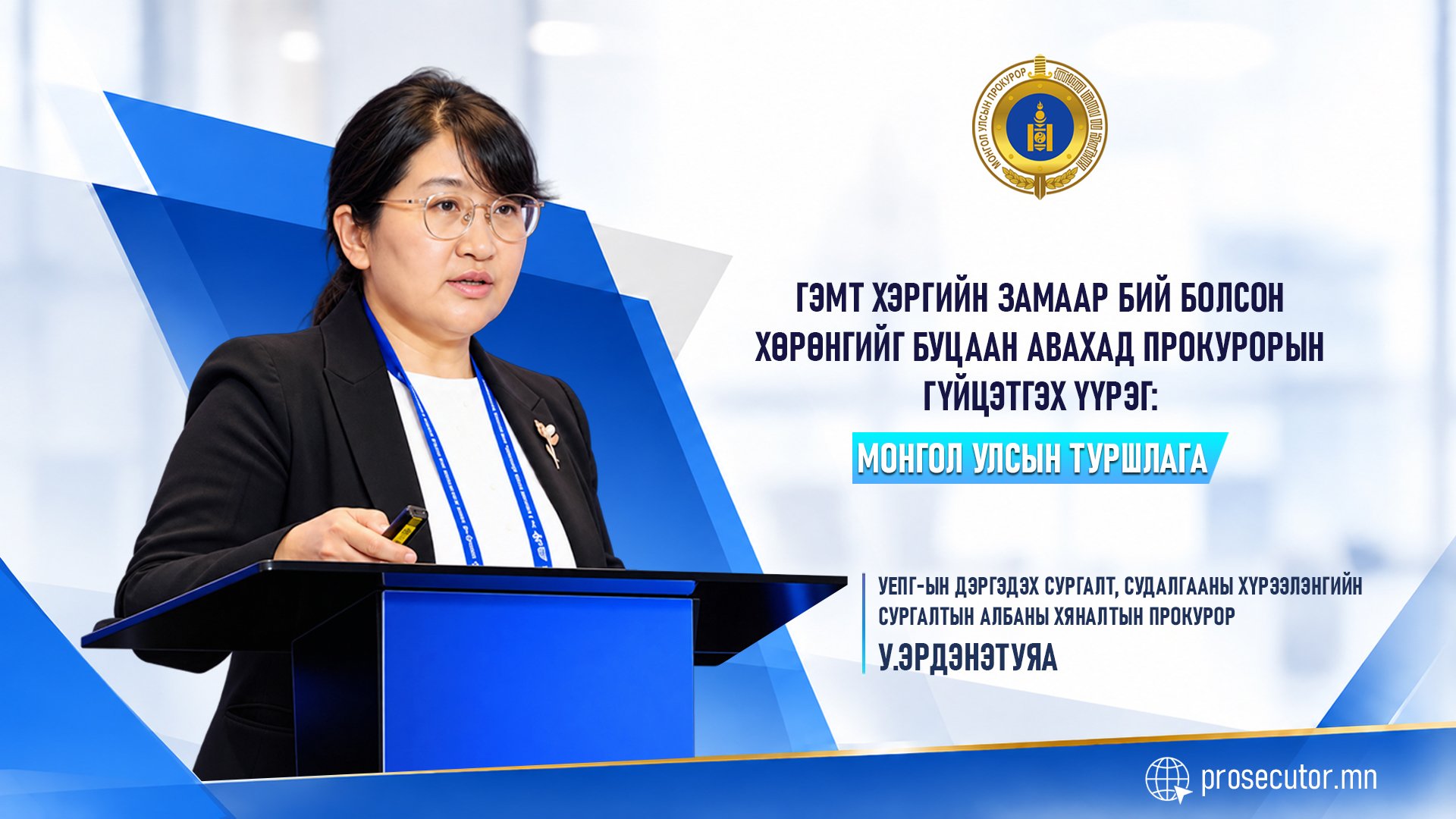
We present the research article “The Role of the Prosecutor in Recovering Proceeds of Crime: The Experience of Mongolia” by U.Erdenetuya, supervising prosecutor of the Training Office of the Training and Research Institute under the GPO, published in the journal “University of the Prosecutor's Office of the Russian Federation”, issued by the University of the Prosecutor's Office of the Russian Federation.
Abstract
In the recovery of assets derived from crime, the prosecution service of Mongolia plays an important role as a “bridge” at every stage, from tracing assets to seizing and securing them, having them confiscated by court decision and recovering them, while ensuring the implementation of international treaties, conventions and standards and of national legislation.
Asset recovery is not limited to the scope of domestic legal regulation; prosecutorial supervision and coordination play a key role in localising and ensuring the implementation of international standards such as the recommendations of the Financial Action Task Force (FATF) and the United Nations Convention against Corruption. The article provides brief information on the national and international instruments followed in asset recovery.
It also presents actual case examples in which the prosecution service of Mongolia successfully recovered illegal assets concealed abroad through mutual legal assistance in criminal matters and other channels of cooperation. Based on this practical experience, specific conclusions and proposals are put forward for increasing the effectiveness of asset recovery and improving its legal regulation in the future.
Keywords: prosecutor, prosecutorial supervision, central authority, asset recovery, transnational crime, mutual legal assistance in criminal matters.
Introduction
With global integration and the rapid development of technology, crimes have come to be committed in a borderless environment using technological advances, making it possible to transfer and convert billions in illegal assets and proceeds to others within a matter of seconds. However, tracing, securing and recovering such assets is heavily affected by factors such as the differing legal systems of countries, language barriers and the capacity of practitioners. This situation now requires us as investigators, lawyers and prosecutors to apply international treaties and conventions effectively, to master electronic evidence standards and technology-based investigative methods, and to further intensify and strengthen our formal and informal international cooperation.
It is internationally recognised that recovering assets and proceeds derived from crime is not only an important part of criminal proceedings but also a process of strategic importance for ensuring national economic security and the system of justice. In particular, the prosecutor's role in recovering assets derived from crime not only restores and protects the rights of victims but also makes a valuable contribution to, and provides real support for, the sustainable social and economic development of the country.
In recent years Mongolia has intensified the fight against corruption, official misconduct and money laundering and has taken policy and practical steps to recover assets and proceeds illegally placed in foreign countries, achieving concrete results and progress, as noted in the reports and assessments of international organisations.[1]
Mongolia's Legal Framework and International Standards
The prosecution service of Mongolia performs its functions regarding the recovery of assets and proceeds derived from crime in accordance with the following national legislation, namely:
the Criminal Code,
the Law on Criminal Procedure,
the Law on Virtual Asset Service Providers,
the Law on Enforcement of Court Decisions,
bilateral intergovernmental treaties and agreements on legal assistance in criminal matters,
the United Nations Convention against Corruption and the United Nations Convention against Transnational Organized Crime,
the recommendations of the Financial Action Task Force (FATF), all of which it implements in its work.
Article 7.5 (“Coercive measure of confiscation of assets and proceeds”) of the General Part of the Criminal Code of Mongolia provides that assets and proceeds equal in value to the damage caused by a crime shall be compulsorily recovered from the assets and proceeds belonging to the person or legal entity that committed the crime; that confiscated assets and proceeds shall be used to compensate the damage caused to others and to cover the costs of investigating and resolving the case; and that, where the amount of assets and proceeds obtained through the crime exceeds the damage, the excess shall be transferred to the state budget.
In order to achieve the objective of implementing the above provision of the Criminal Code, the investigator carries out, with the prosecutor's permission, the actions provided for in the Law on Criminal Procedure of Mongolia, such as seizing items and documents, monitoring and restricting the movement of assets, and placing them under control. Specifically, where the investigator has reasonable suspicion that assets used to commit a crime, possibly obtained through a crime, or otherwise relevant to the case may be concealed, destroyed or have their ownership transferred, the investigator, on the basis of the prosecutor's permission, entrusts the relevant organisation with monitoring the movement of such assets or restricting such movement. These include:
immovable and intangible assets,
financial and debt instruments,
state registrations, copyrights, patents, certificates, licences and special permits,
movements related to vehicle registration,
transactions and movements of funds held in banks and other financial institutions.
In addition, the measures to be taken in respect of confiscated assets, proceeds and physical evidence are specifically regulated by the Law on Criminal Procedure of Mongolia. These include issues such as:
storage of confiscated assets, proceeds and physical evidence,
attachment of property,
time limits for storing confiscated assets, proceeds and physical evidence,
delivery of confiscated assets, proceeds and physical evidence,
disposition of confiscated and attached assets, proceeds and physical evidence.
Where there are real grounds to believe that assets, proceeds or physical evidence may have a harmful effect on human health, the environment or livestock and animals, or adversely affect public safety, or where they may quickly spoil, be damaged or perish, or deteriorate in quality before the case is finally resolved by the court, and the court finds well-founded the prosecutor's motion that they cannot be returned to their owner, the court may, under the Law on Criminal Procedure of Mongolia, make one of the following decisions:
transfer them to the relevant organisation according to need,
transfer them to the relevant organisation for safekeeping,
sell them and keep the proceeds in a special account,
transfer them to the relevant organisation for destruction.
Furthermore, in their day-to-day work prosecutors handle and supervise the receipt, storage and transfer of confiscated and attached assets, proceeds and physical evidence, their return to their lawful owners, and their conversion into state revenue. For instance, prosecutors follow in their work the
“Procedure for the Disposition of Assets, Proceeds, Bail Money and Physical Evidence Confiscated or Attached in Criminal and Infringement Cases”,
“Procedure for Receiving, Storing and Transferring Case Files”,
“Procedure for Confiscating, Securing, Storing and Protecting, Transferring and Disposing of Assets, Proceeds, Physical Evidence and Items in Criminal Cases”, and
“Template for the Register of Confiscated Assets, Proceeds and Physical Evidence”.
Where the prosecutor closes a case at the case registration stage or dismisses a case, the prosecutor submits a motion to the court to have confiscated or attached assets, physical evidence, proceeds obtained through criminal acts and other equivalent items returned to their lawful owners or converted into state revenue.
Under Article 22 of the Law of Mongolia on the Prosecution Service, the enforcement of court decisions is likewise carried out uniformly under prosecutorial supervision. Specifically, when a bailiff enforces a court decision on applying the coercive measure of confiscation of assets and proceeds in accordance with the Law of Mongolia on Enforcement of Court Decisions, the prosecutor supervises whether, for the purpose of compulsorily confiscating without compensation the items and assets specified in the decision and converting them into state revenue, enforcement is carried out by way of
transfer to the relevant state organisation,
sale,
depositing the resulting proceeds into the state budget.
In carrying out these actions, the bailiff bears the duty to ensure the safekeeping, protection and integrity of the assets concerned and is obliged to take the necessary measures provided for by law.
Moreover, with the adoption and implementation in 2021 of the “Law on Virtual Asset Service Providers”, Mongolia is considered to have brought virtual assets out of the “invisible” environment and enabled law enforcement agencies to trace, freeze and confiscate them in the same way as traditional assets. Under this law, infringement case proceedings conducted by authorised officials, such as those of the Financial Information Unit, which is the entity obliged to report suspicious transactions, and the Financial Regulatory Commission, which is empowered to temporarily restrict the right to dispose of assets, are inseparably linked to prosecutorial supervision. At present, the procedure for recovering virtual assets derived from crime is not specifically regulated by Mongolia's international treaties or national legislation; however, the relevant actions can be carried out within the framework of the general provisions of the Law on Criminal Procedure.
In addition, Article 26.2 of the Law of Mongolia on the Prosecution Service provides that legal assistance in criminal matters may be provided on the basis of the internationally established principle of reciprocity and this applies equally to the organisation of asset recovery.
The main purpose of drafting a request for legal assistance on asset recovery is to send to a foreign country, for enforcement there, a court decision on confiscating the assets and converting them into state revenue or on compensating the damage caused to the victim. In this sense, bilateral treaties and agreements on mutual legal assistance in criminal matters concluded with the governments of other countries can be used as the legal basis for enforcing abroad a decision of a Mongolian court on confiscating assets and converting them into state revenue.
In addition to the above national legal provisions, Mongolia takes into account the provision of the United Nations Convention against Corruption on member states taking, in accordance with their domestic legislation, the legislative and other measures necessary for the competent authorities to dispose of assets and proceeds frozen or attached in the territory of a foreign state or recovered pursuant to a court decision, as well as recommendations of the Financial Action Task Force (FATF) aimed at the effective implementation of asset recovery, such as Recommendations 4, 30, 31, 38 and 40; it is implementing asset recovery as a policy priority and continues to learn from other countries and accumulate experience.
The Role of the Prosecutor
In Mongolia, the prosecution service is the central node of the entire process of tracing, attaching or freezing, and recovering illegal assets. The prosecutor is the principal actor who coordinates investigations not only domestically but also at the international level and, by working with competent foreign authorities and international networks, carries out and continuously supervises the task of recovering illegal assets and proceeds placed abroad and returning them to the state budget.
In particular, in recovering assets lost through transnational corruption and official misconduct, the prosecution service of Mongolia not only ensures the intensity of investigations but also actively uses legal assistance in criminal matters and informal channels of international cooperation.
In other words, in recovering assets derived from crime, the prosecutor has the following powers in accordance with Mongolia's domestic laws and international treaties and conventions, namely:
within the framework of supervising investigations, activating financial investigations and giving the investigator prosecutorial instructions to trace the flow of assets and establish their location and beneficial owner,
once the location of assets has been established, freezing and attaching them in order to secure them, and restricting the movement of assets by a prosecutor's resolution,
in accordance with certain bilateral treaties and agreements, the General Prosecutor's Office of Mongolia, as the “central authority” for mutual legal assistance in criminal matters, sending requests for legal assistance on attaching assets to the “central authority” of a foreign state and ensuring their execution,
cooperating and exchanging relevant information with international network organisations such as the International Association of Prosecutors, ARIN-AP and SEAJust in order to ensure the prompt execution of requests for legal assistance and strengthen the capacity of prosecutors,
obtaining national court decisions on recovering assets and proceeds illegally placed abroad,
enforcing such court decisions, recovering the assets and proceeds and having them converted into state revenue,
supervising the implementation of international treaties and conventions and national legislation throughout all of the above processes.
Mongolia's Experience: Examples of Asset Recovery Cases
In recent years, by intensifying the fight against transnational corruption and money laundering, the prosecution service of Mongolia has successfully recovered illegal assets from foreign countries in several cases of corruption, official misconduct and money laundering that were successfully resolved in court.
Let us present some cases in which assets and proceeds derived from crime were successfully recovered.
One. A case of asset return through the enforcement of a foreign court decision
Case of recovering dinosaur bones
A citizen of the Republic of Korea was convicted of the crime of “Money laundering” by a decision of a court of the Republic of Korea. The citizen had illegally placed the assets obtained through the crime in Mongolia, that is, had converted them into a hotel. The General Prosecutor's Office of Mongolia received a request for the recovery of these assets from the Supreme Prosecutors' Office of the Republic of Korea in 2011. Specifically, the above citizen of the Republic of Korea had raised funds through more than 70 transfers in total, established a company in Mongolia in the name of his uncle and converted the assets by having a hotel built; the Supreme Prosecutors' Office of the Republic of Korea granted the General Prosecutor's Office of Mongolia a power of attorney to represent it in the proceedings to enforce the Korean court decision on confiscating these illegal assets. Following a decision of a Mongolian court, whose jurisdiction was determined by the Supreme Court, on enforcing the decision of the court of the Republic of Korea in Mongolia, a writ of execution was issued and the General Executive Agency of Court Decisions of Mongolia organised the enforcement proceedings. In doing so, the hotel was attached and put up for auction. The 65 percent of the hotel that had been sold on to others was also put up for auction and sold. As a result, the amount specified in the decision of the court of the Republic of Korea was confiscated and, in December 2012, transferred to the Korean side to the account specified in that decision, thereby successfully completing the return of assets worth 1.6 million US dollars between the Republic of Korea and Mongolia in a “Money laundering” case. | |
Two. Cases of recovering assets from foreign countries.
Cases of cooperation with the United States, the Republic of Korea and France
The 2016 and 2017 cases of dinosaur fossil finds (USA – Republic of Korea – Mongolia)
| |
The London real estate case, recovered in 2022 (United Kingdom of Great Britain and Northern Ireland – Mongolia)
| |
The main difficulties encountered in investigating and resolving the above cases include
dealing with tax havens and offshore jurisdictions, in particular when establishing the beneficial owner of assets,
the conversion of assets using cryptocurrency,
delays in the execution of requests for legal assistance in criminal matters.
Conclusion
In conclusion, the fight against, prevention and adjudication of transnational crime, in particular corruption and money laundering, cannot be effective without the active participation of the prosecution service.
In Mongolia, as in other countries, the prosecutor performs his or her functions within the framework of the law and international treaties, and in particular serves as the leading central coordinator that brings together the organisation of the recovery of illegal assets and proceeds from abroad, investigations and international cooperation.
In order for the prosecutor's functions in combating transnational crime to be implemented even more effectively in the future, Mongolia could take the following steps. Specifically,
Focusing on capacity building: training prosecutors specialised in tracing virtual assets (cryptocurrency) and analysing blockchain technology,
obtaining formal and informal assistance through international network organisations such as the International Association of Prosecutors, ARIN-AP and SEAJust, further intensifying cooperation, learning from one another and strengthening capacity,
Improving the legal framework: setting out more clearly in domestic legislation the mechanism of confiscating assets and converting them into state revenue without a criminal conviction (non-conviction based forfeiture), that is, civil forfeiture of assets, and bringing it into line with international standards,
Asset management system: learning from the good practices of other countries on increasing the transparency of the management of assets recovered from abroad, including their receipt, allocation and use for public good (such as schools and hospitals), and on establishing a special fund and dedicated structure responsible for this matter, among other things.
Finally, it should be noted that further intensifying the recovery of assets and proceeds derived from crime is of strategic importance for compensating the damage caused to society and the economy and, in turn, for reducing and stopping the financial flows of transnational organised crime.
Source: Bulletin of the University of the Prosecutor's Office of the Russian Federation No. 4 (114) 2026